






The Honest, Step-by-Step Guide to a Hearing Test in Tullamore
If you’ve been putting off booking a hearing test in Tullamore, you’re not alone. Most people who walk through our door on Patrick Street have been thinking about it for months, sometimes years. A family member has been nudging them (“you keep turning the telly up”), or they’ve started asking people to repeat themselves at the dinner table.
This is the honest, plain-English guide to what actually happens at a hearing test in Tullamore — start to finish. No jargon, no upsell, no pressure.
Why the wait isn’t worth it?
We see the same pattern week after week at our Tullamore clinic. People wait an average of seven years between noticing a hearing problem and getting it checked. By then, the brain has adapted around the loss, which makes any future treatment harder to settle into.
A hearing test in Tullamore takes 50 minutes and costs nothing. There’s no good reason to put it off.
The thing nobody tells you about hearing loss is how gradual it is. You don’t wake up one morning unable to hear. It creeps in slowly over months and years — a missed word here, a misheard name there, the TV volume creeping up two notches every winter. Because the change is so slow, your brain quietly compensates for it. You start lip-reading without realising. You avoid the noisy end of restaurants. You stop ringing certain friends because phone calls are harder than face-to-face.
By the time you finally book a hearing test in Tullamore, you’ve usually been adapting for years. The early signs are easy to miss because they don’t feel like “hearing loss” — they feel like the world has just got a bit muffled. That’s the brain doing its job. The audiogram is what cuts through all of that and shows you the actual picture.
1. The chat — the first ten minutes
The first part of your appointment isn’t actually a test. Rose (or whichever HearMed audiologist you’re seeing) will ask about your hearing history, your work, your hobbies, and whether anyone in your family has hearing loss.
It sounds like small talk, but it’s not. Hearing loss is rarely random — it’s shaped by what you’ve been exposed to. A farmer who’s spent forty years near tractors has a completely different pattern from someone who worked in a quiet office. Knowing your story helps us read your results properly.
If you’ve noticed anything specific — a ringing sound, one ear feeling blocked, trouble in restaurants — tell us. Write it down before you come in if you think you’ll forget on the day.
We also ask about general health. Diabetes, high blood pressure, certain medications, head injuries, and ear infections in childhood can all influence hearing in ways that aren’t obvious. None of this is nosiness — every question is there to help us interpret what we see in your audiogram a few minutes later.
If you’ve worn hearing aids before, bring them with you. If you’ve had a previous test elsewhere, bring the results if you have them. The more context, the better.
2. A proper look inside your ears
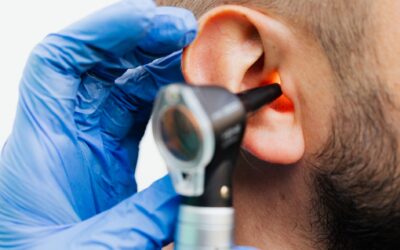
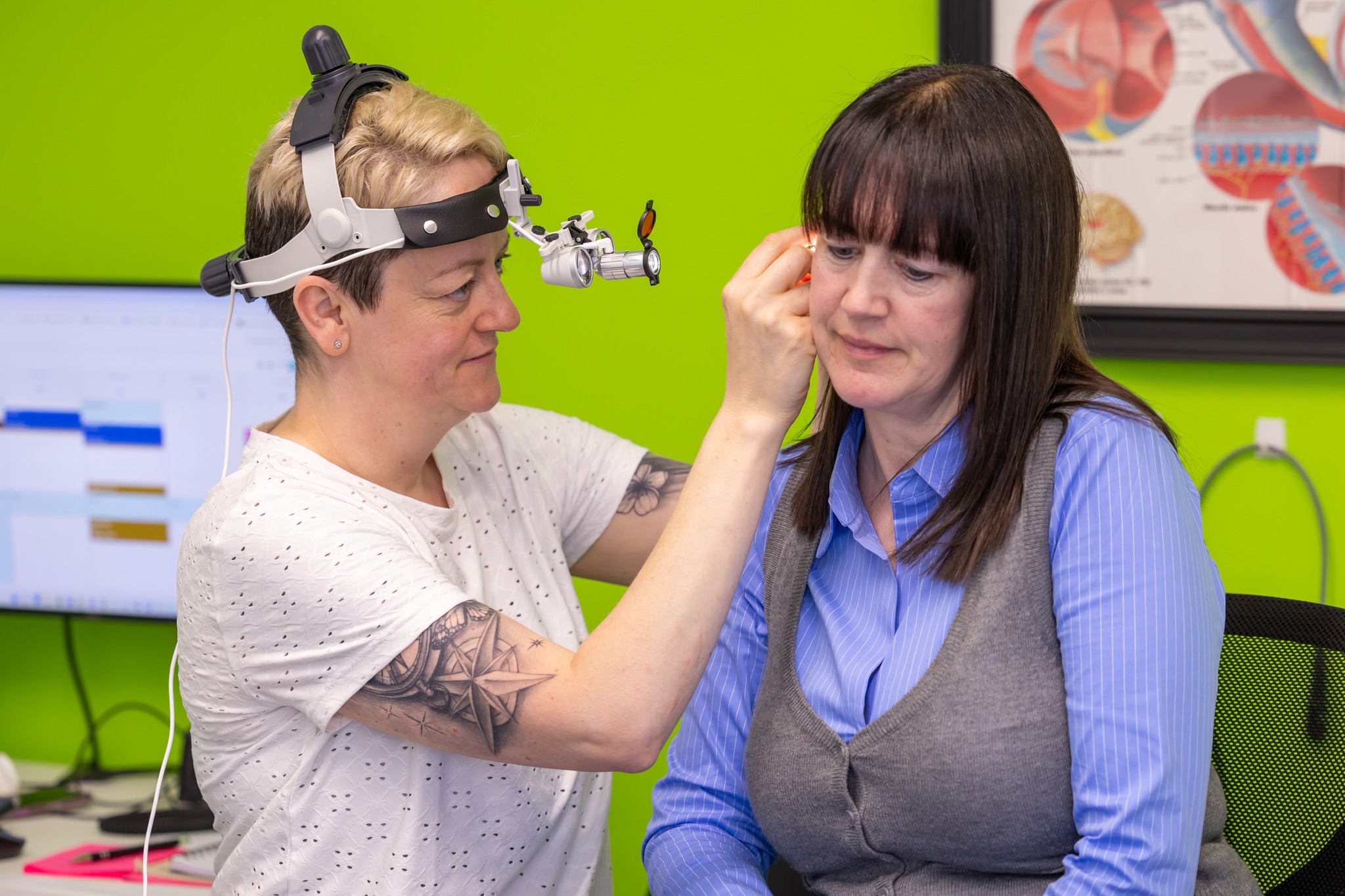
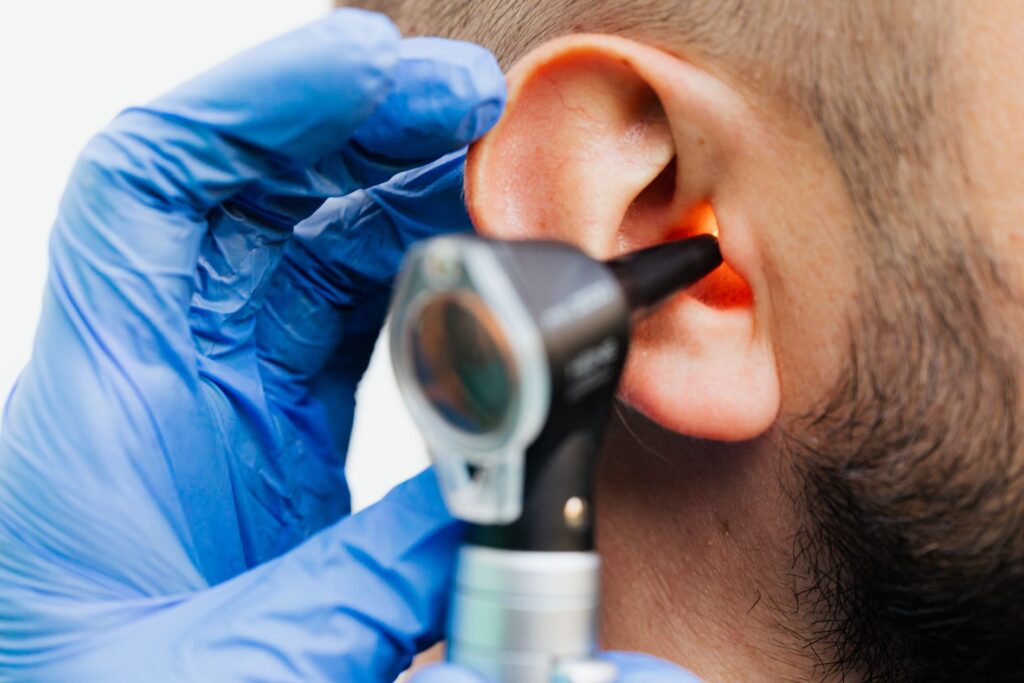
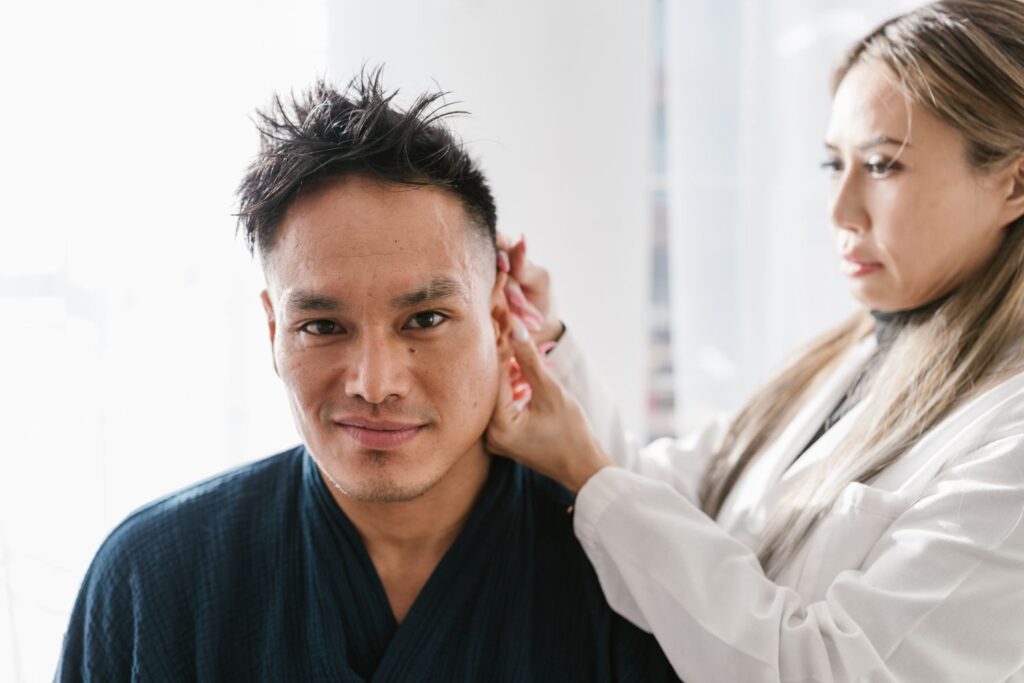
Next comes the otoscopy. We use a small light to look inside each ear canal — the same instrument your GP uses, but we spend a bit more time with it.
We’re checking three things:
- Is the canal clear, or is there wax blocking the view?
- Is the eardrum healthy and intact?
- Is there any sign of infection or irritation?
If there’s significant wax build-up, you can’t get a reliable result until it’s cleared. We’ll either remove it on the spot with microsuction (book a separate slot for this — it adds about 30 minutes) or ask you to come back once it’s gone.
A surprising number of “hearing problems” turn out to be wax. We see people every week who’ve convinced themselves they’re going deaf when really their ear canal is blocked. The relief on their face once it’s cleared is one of the nicest parts of the job. It’s not always that simple, of course — but if it is, we’d rather find out in five minutes than have you walk out with hearing aids you don’t need.
We’re also looking for anything unusual: scarring on the eardrum from past infections, fluid behind it, signs of a perforation that hasn’t healed, or any growth or polyp that should be reviewed by ENT. If we see something that needs medical attention, we’ll write to your GP and explain exactly what we found.
3. The audiogram — the part most people picture
This is what most people think of when they imagine a hearing test in Tullamore: a quiet room, a pair of headphones, a series of beeps.
You’ll sit comfortably and we’ll play sounds at different pitches (low rumbles up to high whistles) and different volumes. You press a button or raise your hand every time you hear one — even if it’s so faint you’re barely sure.
We’re not testing how well you can hear normal speech. We’re mapping the quietest sound you can detect at every frequency, in each ear separately. That map is called an audiogram, and it’s the foundation of everything we do next.
The frequencies we test cover the full range used in everyday life — from the low rumble of a passing lorry up to the high-pitched consonants that make speech intelligible (“s”, “f”, “th”). Most age-related hearing loss starts at the high end, which is why people often say “I can hear you, I just can’t make out what you’re saying”. The vowels are still coming through fine; it’s the consonants that have gone fuzzy.
The test only takes a few minutes per ear. There’s no pain, nothing invasive, nothing to be nervous about. The hardest part is resisting the urge to press the button when you think a beep might be coming — guessing actually messes up the result, so we’d rather you wait until you’re genuinely sure.
If you’re a bit anxious about being in the booth, just tell us. We can leave the door propped open, slow the pace down, or take a break in the middle if you want. None of this is a pass-or-fail exam.
4. The speech test — the bit that matters in real life
After the tones, we run a speech test. We say words at a conversational volume and you repeat them back.
This is the part that often surprises people. You can have textbook-perfect tone results and still struggle in noisy pubs or family gatherings. Tone hearing and speech understanding are two different skills, and a proper diagnostic measures both.
If anything looks unusual, we’ll add a tympanometry test (a quick puff of air that checks middle-ear function) and possibly bone-conduction testing. Bone-conduction is exactly what it sounds like — we use a small vibrating headset on the bone behind your ear to bypass the outer and middle ear entirely. The difference between your air-conduction and bone-conduction results tells us whether a problem is in the mechanical bits of your ear (the wax, eardrum, tiny bones) or in the nerve itself.
We’ll also sometimes test your speech understanding in background noise. This is a fairer reflection of the real world than testing in silence. If you do well in quiet but poorly in noise, that’s a clue that you might benefit from hearing aids with directional microphones — even if your basic audiogram looks borderline.
5. Going through your results together
This is the part rushed clinics skip — and it’s the part that matters most.
We’ll show you your audiogram on screen and walk through it line by line. You’ll see exactly which frequencies are clear and which are starting to fade. We’ll explain what that means in real life — why you can hear your wife fine in the car but lose her in a restaurant, for example.
Three outcomes are possible:
- Normal hearing. Brilliant. Come back in two years.
- Mild loss. We’ll talk about whether you need anything done now or whether monitoring is enough.
- Moderate or worse loss. We’ll talk about options — hearing aids if they’ll genuinely help, a referral to ENT, custom plugs for noisy work, or a follow-up scan. We don’t push hearing aids on people who don’t need them.
We’ll always give you a copy of your audiogram to take home, whether you want it printed or emailed. It’s your data, and if you ever want a second opinion or move clinics, you should have it. Most people find it useful for the simple reason that they can compare future tests to it and see whether anything is changing.
If hearing aids do come up in the conversation, we go through your options without any pressure. Brand, style (behind-the-ear, in-the-ear, receiver-in-canal), rechargeable versus battery, Bluetooth connectivity, level of automation — there’s a lot to think about and we don’t expect you to decide on the day. We’ll book a follow-up if you want to come back with a partner or family member.
6. What it costs (and what doesn’t)
A hearing test in Tullamore at HearMed is free. No hidden fees, no “consultation charge”, no follow-up costs to get your results.
If you have PRSI contributions, you may qualify for the Treatment Benefit Scheme, which provides a contribution toward the cost of hearing aids (not the test itself) of up to €1,000 (€500 per ear). Our audiologists are on the panel and will do an eligibility check for you on the day — just make sure to bring in your PPS number.
You can also claim 20% tax relief on the cost of hearing aids as a medical expense on your end-of-year return.
For most working adults who’ve paid PRSI long enough, the Treatment Benefit Scheme and the tax relief combined make a meaningful difference to the final cost of a pair of hearing aids. Self-employed people and PAYE workers usually qualify; pensioners often do too, depending on their record. We see the eligibility paperwork every day, so if you’re not sure, just ask. There’s no harm in checking.
What hearing aids actually cost varies hugely. Entry-level devices start at a few hundred euro per ear. Premium devices with the latest noise-reduction and Bluetooth features can be several times that. We’ll always show you the full range so you can make an honest comparison. And we never quote you a price for something you didn’t ask about — if your hearing is fine, the test is free and you go home with nothing to buy.
7. When you should book
Don’t wait for “something to be wrong” before booking a hearing test in Tullamore. The honest signs that it’s time:
- You’re over 50 and haven’t had one in five years
- People around you say the telly is too loud
- You struggle in pubs, restaurants, or family gatherings
- One ear feels blocked or different from the other
- You have ringing, buzzing, or hissing (tinnitus)
- You work in noise — farming, construction, music, manufacturing
- A close family member has hearing loss
The single biggest mistake we see is people who wait years between noticing a change and getting checked. The brain adapts. The longer you leave it, the trickier the adjustment when you finally do something about it.
Hearing health is a vital part of your overall wellness regime. You get your bloods done annually, you go to the dentist, you might have an eye test every two years — it’s important to add a hearing test to your overall wellness regime too. Annual or biennial hearing checks are the norm in most other developed countries, and there’s no good reason Irish adults shouldn’t follow the same routine.
There’s a growing body of research linking untreated hearing loss to social withdrawal, cognitive decline, and dementia risk. We’re not raising that to scare you — we’re raising it because it’s the most under-talked-about reason to look after your hearing early. The point isn’t to panic; it’s just to add a hearing test to the list of normal grown-up things you do once a year, in the same breath as your bloods and your blood pressure.
Common myths about a hearing test in Tullamore
A few things we hear from patients almost every week — none of them true:
“It’ll be painful.” It isn’t. Nothing goes into your ear during the actual hearing test other than a soft foam tip on the headphones. Even microsuction for wax — which is a separate appointment — is gentle. We use no water, no syringing.
“They’ll just try to sell me hearing aids.” Not at HearMed. If your hearing is fine, you’ll be told it’s fine and sent home in 45 minutes. We’d rather have you back for another free check in two years than sell you something you don’t need.
“It takes forever.” A full diagnostic test is 45 minutes door-to-door. That’s less time than a haircut.
“I’ll have to wait weeks for an appointment.” Usually within a week, sometimes the same week. Call and see.
“Hearing aids are huge, beige, and whistle all the time.” They were 20 years ago. Modern devices are tiny, rechargeable, Bluetooth-enabled, and as discreet as you want them to be. The whistling (feedback) that older devices were famous for is essentially a solved problem.
“I’m too young.” Hearing loss isn’t only an older-adult thing. We test musicians in their twenties, construction workers in their thirties, and farmers of every age. If you’ve been around noise, get a baseline.
Hearing test in Tullamore vs. a free screening elsewhere
A quick word on the difference between a full diagnostic and the kind of “free screening” you might see advertised in a pharmacy or supermarket pop-up.
A screening is a brief check that gives a yes/no answer: do you appear to have hearing within the normal range, or should you go for a full test? It’s usually 5–15 minutes, often in a noisy environment that isn’t ideal for accurate measurement, and rarely includes the full conversation about your history, the otoscopy, the speech-in-noise testing, or the proper walk-through of results.
A hearing test — which is what you get in Tullamore with HearMed — is the full thing. Audiogram across all relevant frequencies, both ears, in a sound-treated environment, with speech testing, otoscopy, and a proper conversation about what the results mean for your life. And it’s free.
If a screening flags something, you’ll usually be told to get a full test anyway. So it’s worth skipping the screening and going straight to the proper version. You’ll save yourself the trip and you’ll get a result you can actually act on.
A note for family members reading this
Sometimes the person reading this isn’t the person who needs the test — it’s their daughter, son, or partner. If you’re trying to gently nudge a family member into booking a hearing test in Tullamore, here’s what we’ve learned helps:
- Frame it as a routine check, not a confrontation. “When did you last have your hearing tested?” lands much better than “You can’t hear me anymore.”
- Mention that it’s free and only takes 50 minutes. The two practical objections most people have are time and money, and both are off the table here.
- Offer to come with them. Lots of patients bring a spouse or adult child into the results discussion — a second pair of ears is genuinely useful.
- Don’t push hearing aids. The aim is just to get the audiogram. Whatever happens after that, happens later.
People rarely book a hearing test the same day the conversation starts. They mull it over for weeks or months. That’s normal. The goal is to plant the idea, not to win the argument.
What happens after the test
If your hearing is normal, you’ll leave with a copy of your audiogram and a reminder to come back in two years. That’s it. Nothing else to do.
If we find a mild loss, we’ll usually suggest monitoring — come back in twelve months and see whether the picture has shifted. There’s often no need to do anything immediately, and we’d rather track it than rush you into a decision.
If we find a moderate or worse loss, the next conversation is about what to do. Usually that means trying hearing aids, which we’ll demonstrate in the clinic so you can hear the difference for yourself. If you decide to go ahead, we’ll book a fitting appointment 7–14 days later — that’s the gap we need to get your custom moulds or fitted devices made up. Once you have them, you come back for a follow-up at 2 weeks, 6 weeks, and 3 months to fine-tune the programming as your brain gets used to hearing properly again.
If we find something we think needs medical review — a perforation, a one-sided loss that’s appeared suddenly, anything that doesn’t fit a typical pattern — we’ll write to your GP and recommend an ENT referral. We won’t sell you a hearing aid in a situation where you need a doctor first.
Where we are
HearMed Tullamore is on Patrick Street, Tullamore, Co. Offaly. We are right beside the Credit Union. There’s parking nearby, with disabled parking right outside our door, and the clinic is on the ground floor — so that means no stairs to worry about. We’re open Monday to Friday 9am–5pm with some Saturday slots depending on the clinicians’ availability.
To book a hearing test in Tullamore, call 057 934 9388 or use the online booking on our Tullamore clinic page. We’ll usually fit you in within a week.
If you’ve been thinking about it for a while, just book the appointment. The hardest part is making the call. Everything after that is straightforward.
FAQ
How long does a hearing test in Tullamore take?
About 50 minutes for a full hearing test — the chat, otoscopy, audiogram, speech testing, and going through your results. Quick screenings elsewhere are shorter but won’t give you anything actionable.
Is a hearing test in Tullamore free?
Yes. A hearing test in Tullamore at HearMed is free. Some other clinics charge €50–€80 for a full test.
Do I need a GP referral?
No. You can book a hearing test in Tullamore directly with HearMed. If we find something that needs medical attention, we’ll write to your GP for you.
Will I need hearing aids if I do a hearing test?
Not necessarily. Plenty of people leave reassured that their hearing is fine, or with advice on monitoring it. We only recommend hearing aids when they’ll actually help. But either way, our audiologists are trained to help guide you through every step of this journey.
Can children be tested?
Yes. We test children from around age 12. For younger children we may refer to a specialist paediatric audiologist.
What should I bring with me?
Just yourself and a list of any medications you take. If you’ve had a previous hearing test, bring the results. If you wear hearing aids already, bring them so we can check the settings and fit.
Can I bring someone with me?
Absolutely. We actively encourage it. A partner, adult child, or close friend in the room during the results conversation is genuinely useful — they often notice things in everyday life that the patient hasn’t connected to hearing.
How often should I have a hearing test in Tullamore?
Every two years from age 50, or annually if you’ve already been diagnosed with any degree of hearing loss, work in a noisy environment, or have a strong family history. For most adults under 50 with no symptoms, every 3–5 years is fine.
Will my hearing test results be shared with anyone?
Only with your consent. We’ll write to your GP if there’s something they need to know clinically, and we’ll happily share results with another audiologist if you ask. Otherwise your audiogram stays with us.
Last reviewed: June 2026 by Rose Mullaney, BSc Audiology (Anglia Ruskin University, Cambridge).
HearMed Acoustic Healthcare, Patrick Street, Tullamore, Co. Offaly. Phone 057 934 9388.
Hero image by kaboompics on Pexels. In-body image by RDNE Stock project on Pexels.