






The Honest, Complete 2026 Guide to Hearing Tests in Ireland
By Rose Mullaney, BSc Audiology, Anglia Ruskin University, Cambridge — HearMed Medically reviewed and last updated: 9th July 2026
If you’ve ever asked the person beside you to repeat themselves for the third time and thought “maybe it’s just me being tired”, you’re in good company. Half the patients who come through our clinic doors in Tullamore booked their first appointment because a family member finally lost patience with the telly volume. This is the honest, plain-spoken guide to hearing tests in Ireland in 2026 — what they are, what they cost, what actually happens on the day, and how the PRSI Treatment Benefit Scheme works when you need hearing aids afterwards.
We’ve written this as a proper pillar guide because there’s a lot of vague, half-imported UK content floating around the Irish web on this topic, and Irish patients deserve better. Hearing tests in Ireland aren’t the same as in the UK or the US. The pricing is different, the eligibility rules are different, and the way most private clinics (including ours) run the appointment is different. So let’s walk through all of it.
What a hearing test actually is
A hearing test is a structured, painless assessment of how well your ears — and the auditory pathways behind them — pick up sound across the frequencies that matter for everyday listening. In Ireland, when people say “hearing test” they usually mean one of three things: a screening test (a quick pass/fail check, sometimes at a pharmacy or a health fair), an audiometric assessment (the full 50-minute assessment we do in clinic), or a specialist test for something specific like tinnitus management or an occupational hearing test.
For most adults over 40 wondering “am I losing my hearing?”, it’s the audiometric assessment you want. That’s what we mean throughout this guide when we talk about hearing tests in Ireland — the full assessment, not a five-minute pharmacy screening.
At HearMed, an audiometric assessment takes 50 minutes and is completely free. No consultation fee, no follow-up charge, no pressure to buy anything at the end. If we find nothing wrong, we will give you the good news that your hearing is normal and send you on your way with a copy of your audiogram.
Why hearing tests in Ireland matter more than people realise
Ireland has a hearing-health problem it doesn’t talk about much. Estimates from the HSE on hearing loss suggest one in six adults in Ireland has some degree of hearing loss, and the number climbs steeply after age 60. Most of them wait an average of seven to ten years between first noticing a problem and doing something about it.
That delay is not harmless. Research in the last decade has linked untreated hearing loss to social withdrawal, higher rates of depression, poorer balance, and — the one that makes people sit up — an increased risk of cognitive decline and dementia. This is why hearing tests in Ireland are quietly one of the most important checks you can do in your 50s and 60s, and yet the one most people put off longest.
Getting a hearing test doesn’t commit you to anything. It’s information. If your hearing is fine, brilliant. If it’s slipping, you catch it early, when hearing aids work best and the brain adapts easiest. Nobody regrets finding out early. Plenty of patients tell us they wish they’d come in five years sooner.
Who should book a hearing test — and when
You should book a hearing test in Ireland if any of these sound familiar:
- People seem to mumble more than they used to.
- You struggle to follow conversation in a pub, restaurant, or family gathering.
- The telly volume creeps up and the family complains.
- You ring in your ears — a hum, a whistle, a hiss — especially at night.
- You’ve had a lot of noise exposure over the years (farming, construction, music, army service, motorbikes).
- You had a bad cold, ear infection, or a knock to the head and something feels off.
- You’re over 60 and haven’t had your hearing checked in the last two years.
- Somebody in your family — parents, siblings — has hearing loss.
You should also book if a GP or a family member has flagged it, even if you don’t believe them. We see this all the time. The person with the hearing loss is often the last one to notice.
For children, the story is different. In Ireland, newborn hearing screening is done in hospital in the first days of life, and school-age screening picks up most problems after that. If you’re worried about a child’s hearing, the first port of call is your GP, who can refer to paediatric audiology on the HSE. At HearMed we test children from age 12 onwards. Under 12s go through the paediatric service where the specialist protocols and play-audiometry equipment live.
The main types of hearing tests in Ireland
Not every hearing test is the same. Here are the ones you’ll actually come across.
- Free screening tests. Quick, usually 10–15 minutes, often done at a pharmacy, community event, or online. They tell you “probably fine” or “probably worth a proper look”. They don’t give you an audiogram and they don’t diagnose anything. Useful as a nudge, not a substitute for a real test.
- Audiometric assessment (the 50-minute test). This is the standard adult hearing assessment. Pure-tone audiometry across the speech frequencies, bone-conduction testing, speech-in-quiet, and usually a tympanogram (a middle-ear pressure check). You leave with a printed audiogram and a plain-English explanation. This is what most private audiology clinics in Ireland — HearMed included — offer as their core service.
- Speech-in-noise testing. An extra layer on top of the standard audiogram. We play sentences with background noise and see how well you follow them. Two people can have the same audiogram and completely different real-world hearing, and this is the test that shows it.
- Tinnitus assessment. For patients whose main complaint is ringing, hissing, or buzzing rather than volume. We match the pitch and loudness of the tinnitus, check for any underlying hearing loss driving it, and talk through management options. Not every clinic in Ireland does this — HearMed does.
- Paediatric audiology (under 12). Done through HSE community audiology services. Uses play-based techniques, otoacoustic emissions, and visual reinforcement audiometry. This is not the same as an adult hearing test and shouldn’t be done as one.
- Occupational / pre-employment audiometry. Required for some jobs — Garda, defence forces, aviation, certain factory roles. We can provide this and issue the formal certificate.
Most of the questions we get about hearing tests in Ireland are about the diagnostic audiogram — so that’s what the rest of this guide focuses on.
What actually happens during a HearMed hearing test — step by step
People are almost always more nervous than they need to be. There are no needles, no bright lights, no small dark rooms. Here’s the honest walk-through.
Minute 0–5: Sit down, cup of tea if you’d like one. The audiologist introduces themselves, checks your paperwork, and asks a bit about why you’re here today. Not a form-filling interrogation — a proper conversation. What have you noticed? Any family history? Any ear infections as a child? Any loud noise exposure? Any tinnitus? Are you on any medications? All useful context.
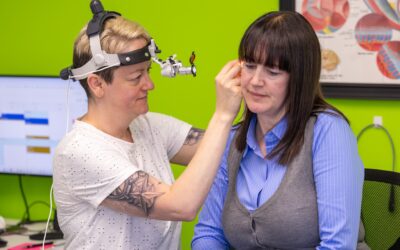
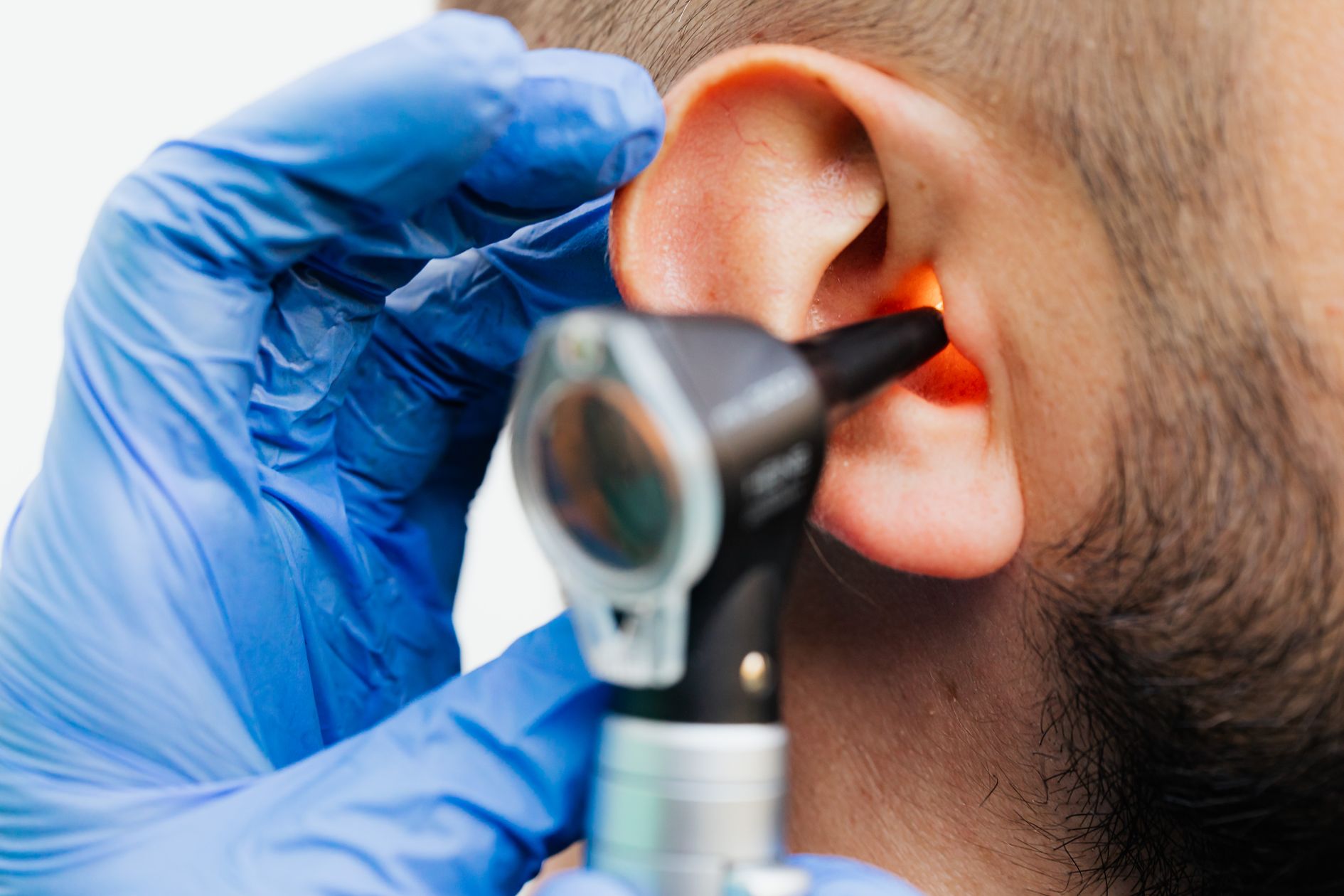
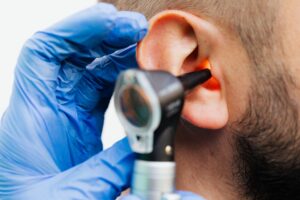
Minute 5–10: Otoscopy. We have a look inside both ear canals with a video otoscope. You’ll see the image on a screen — most patients find this genuinely interesting. We’re looking for wax, redness, perforation, or anything unusual. If there’s impacted wax blocking the eardrum, we’ll pause the hearing test and address it first, because you can’t accurately test hearing through a wall of wax.
Minute 10–15: Tympanometry. A soft rubber tip sits in the ear canal for about 10 seconds while a small pressure change tests how well the eardrum and middle ear are moving. It doesn’t hurt — it feels like a mild popping sensation. This tells us if there’s fluid behind the drum or a stiffness problem the audiogram alone might miss.
Minute 15–35: Pure-tone audiometry (the “beeps in the headphones” bit). You sit in a quiet room with headphones on. We play tones at different pitches and volumes, and you press a button (or raise a finger) every time you hear one. We test each ear separately, at frequencies from 250 Hz up to 8,000 Hz, and mark your responses on the audiogram. Then we swap to a bone-conduction headband and repeat, which tells us whether any hearing loss is in the outer/middle ear or in the inner ear/nerve.
Minute 35–45: Speech testing. You listen to lists of words — sometimes in quiet, sometimes with background chatter — and repeat back what you hear. This is where the real-world impact of your hearing gets measured, and it’s often the eye-opening bit.
Minute 45–50: Results and what next. We print your audiogram, sit down with you, and explain it in plain English. If your hearing is normal, we tell you so, hand you the printout, and suggest re-testing in two to three years. If there’s hearing loss, we explain the pattern, the likely cause, and your options. No pressure. No sales pitch. You go away and think about it. If hearing aids are the right answer, we’ll talk about styles, technology levels, PRSI Treatment Benefit, tax relief, and what a trial would look like — but only if that’s what you want to do that day.
The whole thing is quiet, methodical, and painless. Bring your reading glasses if you use them, bring your PPS number if you’d like us to check your PRSI Treatment Benefit eligibility on the day, and that’s it.
Reading an audiogram — what those squiggles mean
Your audiogram is a chart. Pitch runs left to right (low to high) and loudness runs top to bottom (soft to loud). The higher up on the chart your marks are, the better your hearing at that frequency. Anything above about 20 dB is in the normal range. Between 25 and 40 dB is mild hearing loss. 40 to 60 dB is moderate. 60 to 80 is severe. Above 80 is profound.
Most Irish adults over 55 who come in with a “the wife says the telly is too loud” complaint have a high-frequency sloping loss — normal at the low pitches and dropping off in the 2,000–8,000 Hz range. That pattern is textbook age-related and noise-related hearing loss. It’s the reason speech sounds mumbled: the consonants (s, f, sh, th, k) all live in the high frequencies, and if those disappear, “sixty” and “fifty” and “sixteen” start to sound the same.
We won’t send you home with a chart you don’t understand. Rose or one of the team will walk through your specific audiogram with you and put it in context.
What hearing tests in Ireland actually cost
This is the question we get asked most, so here’s the honest answer for 2026.
- At HearMed: €0. A diagnostic hearing test is free at all six of our clinics — Tullamore, Portlaoise, Portumna, Newbridge, Templemore and Athenry. No consultation fee, no follow-up fee, no obligation.
- At most Irish private audiology chains: also free. Hidden Hearing, Specsavers, and Boots offer free adult hearing tests as standard. This is the industry norm in Ireland for adult diagnostic audiometry.
- Through the HSE: free but with a wait. Your GP can refer you to community audiology on the HSE. Cost is nil, but waiting lists in most Irish counties are long — often several months to over a year in 2026.
- ENT specialist consultation: €150–€250 privately. If your GP suspects a medical cause (sudden hearing loss, one-sided loss, vertigo, ear pain), they may refer you to an Ear Nose & Throat consultant. That’s a paid appointment unless done through the public system.
- Paediatric hearing tests: free through HSE community audiology for children under 12.
For the vast majority of adults, the practical answer to “how much does a hearing test in Ireland cost?” is nothing. Take advantage of it. There’s no reason to put this off on financial grounds.
Free vs paid — is the free one the “real” one?
Fair question. If it’s free, is it any good?
Yes. The free adult hearing test at any of the reputable Irish private clinics — HearMed, Hidden Hearing, Specsavers Ireland, Boots Ireland — is a genuine diagnostic audiogram, done by a qualified audiologist, with the same equipment used anywhere else. The clinics don’t charge because the business model is: patients who turn out to need hearing aids may buy them from the clinic. Patients who don’t, don’t. Either way you leave with a real audiogram and honest advice.
Where you have to be careful is with home-testing kits, phone-app “hearing tests”, and mall-kiosk screenings. These are not diagnostic tests. Some are useful nudges, some are marketing gimmicks. None of them substitute for a proper clinic visit.
The PRSI Treatment Benefit Scheme — the €1,000 most people don’t claim
Here’s the one that genuinely saves patients real money.
If you’ve paid enough PRSI contributions over your working life (Class A, E, H, P, or S — most PAYE workers and most self-employed people qualify), you’re likely entitled to the Treatment Benefit Scheme, which includes a contribution of up to €1,000 towards hearing aids — that’s €500 per ear, once every four years. The scheme also covers dental and optical benefits, which most people know about, but the hearing element is quieter and drastically under-claimed.
Read the full official rules on the Citizens Information page for the Treatment Benefit Scheme. If you’re a dependent spouse of someone with PRSI contributions, you may also qualify — check the same page.
A common question: “How do I check if I’m eligible?” You don’t need to worry about it. HearMed audiologists are on the Treatment Benefit panel, and we check your eligibility on the day of your appointment. Just bring your PPS number to your hearing test. We do the paperwork.
The €1,000 comes off the price of your hearing aids at the point of sale. You don’t have to pay the full amount and claim it back — it’s applied as a discount directly. That’s the practical reality: the hearing test itself is free, and if you need hearing aids afterwards, the PRSI contribution takes a meaningful chunk off the cost.
Tax relief — the extra 20% most people miss
On top of PRSI, hearing aids in Ireland qualify as a medical expense for tax relief at the standard rate (20%). You claim it at the end of the tax year through your Revenue online account, under health expenses.
Worked example. You buy a pair of mid-range hearing aids at €2,800. PRSI Treatment Benefit knocks €1,000 off at the till, so you pay €1,800. At the end of the year you claim €1,800 as a health expense, and Revenue refunds 20% of that (€360) into your bank account. Net cost: €1,440 for a pair of aids that would have listed at €2,800. That’s the arithmetic no one explains to people until they walk into a clinic.
Verify the current relief rate with Revenue at revenue.ie before you claim, in case the rules change.
What if you find out you need hearing aids
If your audiogram shows a loss that hearing aids would help with, the next step at HearMed is a hearing aid consultation — separate from the hearing test itself, no pressure, still free. We talk through:
- What style suits your ears and your lifestyle (behind-the-ear, receiver-in-canal, in-the-canal, invisible)
- Technology level (basic to premium — the difference is mainly in how well the aid separates speech from background noise)
- Rechargeable vs battery
- Bluetooth streaming from your phone or telly
- A two-week home trial so you can actually live with the aids before committing
- Realistic price ranges after PRSI and tax relief
More detail on hearing aid options lives on our hearing aids page. The hearing test is always the first step — you can’t fit a hearing aid without knowing what to fit.
Hearing tests in Ireland by county — where to find us
HearMed runs six clinics across the midlands, west, and southeast. All six do the full 50-minute free diagnostic hearing test.
- Tullamore, Co. Offaly — Patrick Street, right beside the Credit Union, ground floor, disabled parking outside the door. Mon–Fri 9am–5pm plus some Saturday slots. Phone 057 934 9388. This is our flagship clinic and the busiest. For the location-specific breakdown, see our guide on hearing tests in Tullamore.
- Portlaoise, Co. Laois — Phone 057 86 38181.
- Portumna, Co. Galway — Phone 090 970 2984.
- Newbridge, Co. Kildare — Phone 0818 058 058.
- Templemore, Co Tipperary — Phone 0818 058 058.
- Athenry, Co. Galway — Phone 0818 058 058.
Booking is by phone or through the website. Same-week appointments are usually available at all six locations.
If wax is the actual problem
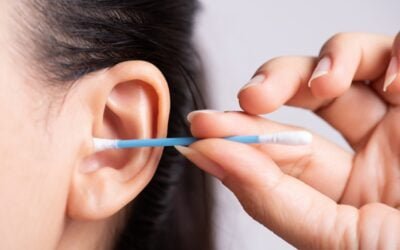
Sometimes what feels like hearing loss is just impacted ear wax. It’s very common — cotton buds push wax deeper (please stop using them), and some ears produce more wax than others no matter what you do. If our otoscopy shows the canal is blocked, we may recommend microsuction ear wax removal first, then repeat the hearing test afterwards for an accurate reading. Full detail on that service is on our ear wax removal page.
Hearing health as part of your yearly wellness regime
Here’s something we say to almost every patient who’s dithered for a few years about coming in.
Hearing health is a vital part of your overall wellness regime. You get your bloods done annually. You go to the dentist. You might have an eye test every two years. It’s important to add a hearing test to your overall wellness regime too. That’s the honest, straightforward frame for hearing checks in general: routine self-care, not a red-alert medical intervention.
In most developed countries, adults over 55 are quietly encouraged to have their hearing checked every one to two years. Ireland is a bit behind on that culture, which is why we bang the drum on it. The World Health Organisation’s World Report on Hearing makes the same point — regular hearing checks belong in adult wellness care, not just as a reaction to a problem.
The link between untreated hearing loss and cognitive decline is now well-established, and while a hearing aid isn’t a magic prevention for dementia, keeping your auditory brain properly stimulated matters. Booking a hearing test every two years after the age of 55 is one of the easiest health habits to build. It’s free. It’s an hour of your morning. It gives you real data.
Common questions about hearing tests in Ireland
How long does a hearing test take? At HearMed, 50 minutes. That includes the conversation, otoscopy, tympanometry, pure-tone audiometry, speech testing, and the results discussion. A quick pharmacy screening is 10–15 minutes but doesn’t give you an audiogram.
Is the hearing test really free? Yes. Free means free. No consultation fee, no follow-up fee, no obligation to buy anything at the end. This is standard across reputable Irish private audiology clinics for adult diagnostic hearing tests.
Does the hearing test hurt? No. No needles, no discomfort. The tympanometry gives a mild pressure sensation for about ten seconds. That’s the strongest sensation in the whole appointment.
What should I bring to my hearing test? Your reading glasses if you wear them, a list of any medications, and your PPS number if you’d like us to check your PRSI Treatment Benefit eligibility on the day. That’s it. You don’t need a GP referral for a private hearing test in Ireland.
Do I need a GP referral? No. You can book a private hearing test directly. A GP referral is only needed if you want to go through the HSE public audiology service, or if your GP suspects a medical issue that needs ENT investigation.
Can I bring someone with me? Yes, and we actively encourage it. A spouse, adult child, or friend in the room is genuinely useful in providing a calm, caring and comfortable environment — they often notice things you don’t, and they hear the same explanation of your results, which helps decisions later.
At what age should children have a hearing test? Newborn screening happens in hospital. School screening picks up most issues after that. If you’re worried about a specific child, see your GP for referral to paediatric audiology on the HSE. At HearMed we test from age 12 upwards. Under 12s go through the paediatric service.
How often should adults have hearing tests? If you have no symptoms and no known hearing loss, every two to three years after age 55 is a reasonable rhythm for a basic screening. If you have noise exposure, tinnitus, family history, or noticed changes, come sooner.
What if the test shows I don’t need hearing aids? Then we tell you that, hand you the audiogram, and see you again in a couple of years. Genuinely. Not everyone who books a hearing test needs an aid, and we’d rather give you honest information than upsell.
What if my hearing loss is only in one ear? That gets flagged for follow-up. Sudden or one-sided hearing loss can have a medical cause and usually warrants a GP visit or ENT referral. We’d explain that on the day and help you take the next step.
Can hearing tests detect tinnitus? The audiogram doesn’t diagnose tinnitus directly, but it identifies any hearing loss underlying it, which is often the driver. We do a separate tinnitus-specific assessment on top if that’s your main concern.
Do you test balance / dizziness at a hearing test? Not routinely. Balance testing (VNG/vestibular assessment) is a separate specialist appointment. If your GP has flagged balance issues, we can advise on referral.
Can I get a copy of my audiogram to bring elsewhere? Absolutely. You leave every HearMed appointment with a printed copy. If you need it emailed as a PDF, we can do that.
How do I book? Ring your nearest clinic directly (numbers above), or use the booking form on any of the location pages on hearmed.ie. Same-week slots are usually available.
The honest bottom line
Hearing tests in Ireland are free at every reputable adult clinic, they take 50 minutes, they don’t hurt, and they give you real information about your own body that you didn’t have before. If you’re eligible for the PRSI Treatment Benefit — most working adults are — the state contributes up to €1,000 toward hearing aids should you turn out to need them, and you can claim another 20% back through tax relief on top of that.
There is genuinely no downside to booking a hearing test. If your hearing is fine, you get told so and you get on with your life with one less thing to worry about. If your hearing is slipping, you catch it early, when the brain adapts easiest and the treatment options are widest. The patients who regret coming in are essentially none. The patients who regret waiting five extra years are many.
If you’re in the midlands, the west, or the southeast and you’ve been meaning to book, ring the clinic that’s closest — Tullamore, Portlaoise, Portumna, Newbridge, Templemore, or Athenry — and we’ll fit you in. Bring your PPS number. Bring your reading glasses. Bring a family member if you’d like. That’s it.
Hearing tests in Ireland don’t have to be a big deal. They’re just an hour of your morning, once every couple of years, in the same rhythm as your dentist and your eye test.
About the author: Rose Mullaney holds a BSc in Audiology from Anglia Ruskin University in Cambridge and leads the clinical team at HearMed across our six Irish clinics. She has fitted over a thousand pairs of hearing aids and personally reviews every diagnostic hearing test carried out at HearMed. Rose is on the PRSI Treatment Benefit panel.
Last medically reviewed: 9th July 2026. Next review due: January 2027.